May 20, 2026
SECAI Fellows Visit the University of Zambia
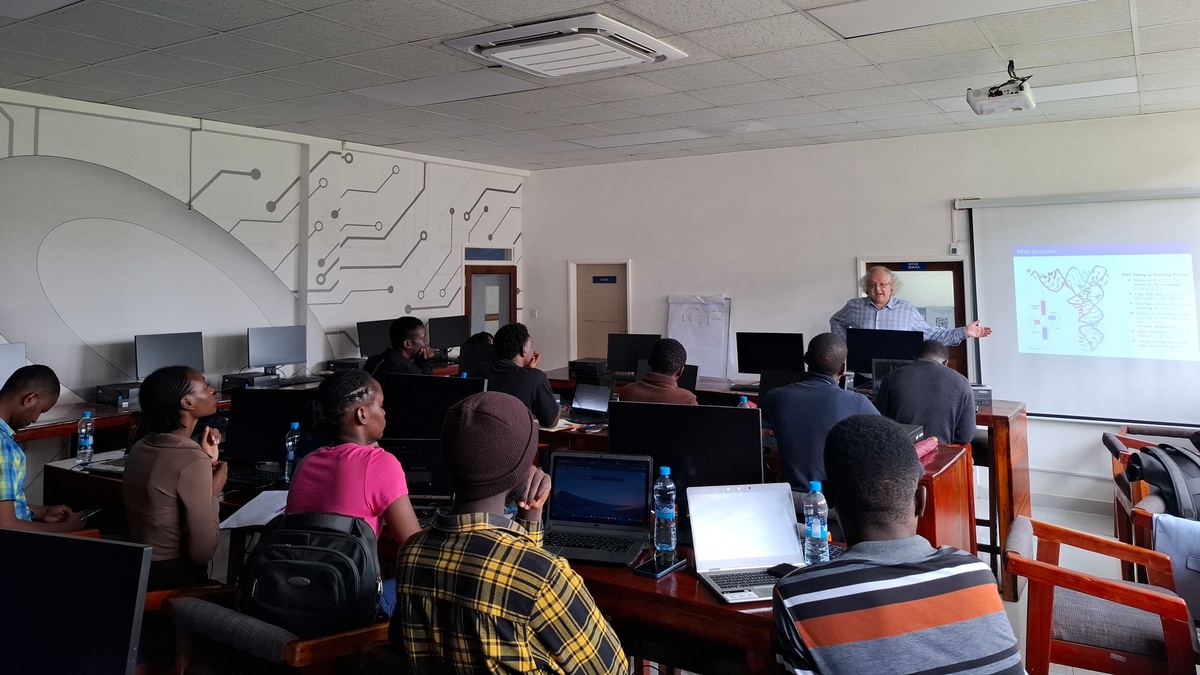
The two-week summer school at the University of Zambia (UNZA), held from February 28 to March 14, brought together master’s students in computer science and electrical engineering with international experts in the fields of artificial intelligence, bioinformatics, and embedded systems. The goal of the event was to provide participants with practical insight into current fields of AI research while strengthening academic exchange between UNZA and partner institutions in Leipzig. The Summer School was organized by Prof. Gerik Scheuermann together with colleagues from UNZA, particularly Amos Banda.
The technical program consisted of two master classes that explored different areas of applied AI. The first master class, “AI in Data Science,” focused on topics such as image analysis, bioinformatics, and neuromorphic systems. The instructors included Gerik Scheuermann, Baldwin Nsonga, Fellow Peter Stadler, and Fellow Martin Bogdan (online), all from the Leipzig University. The program was complemented by the second master class, “Machine Learning on Microcontrollers,” which was designed by Prof. Gerold Bauch and Eric Fischer from the Leipzig University of Applied Sciences (HTWK) and focused on resource-efficient AI applications on embedded systems.
In addition to the academic content, the summer school also provided an opportunity for personal interactions and the establishment of new international connections. On-site, numerous interesting discussions took place with colleagues from Zambia regarding potential future collaborations in research and teaching. It is precisely these kinds of events that demonstrate how international summer schools can help build sustainable academic networks and inspire young talent to pursue AI research at an early stage.
About Peter Stadler
Fellow Peter Stadler is a professor of bioinformatics at the University of Leipzig and deputy director of SECAI. His research focuses on developing a consistent understanding of biological processes – particularly molecular evolution – at the genotypic, phenotypic, and dynamic levels, combining methods from bioinformatics, machine learning, and artificial intelligence with questions in the life sciences.
News All News
 © Ludwig Schmutzler