April 16, 2026
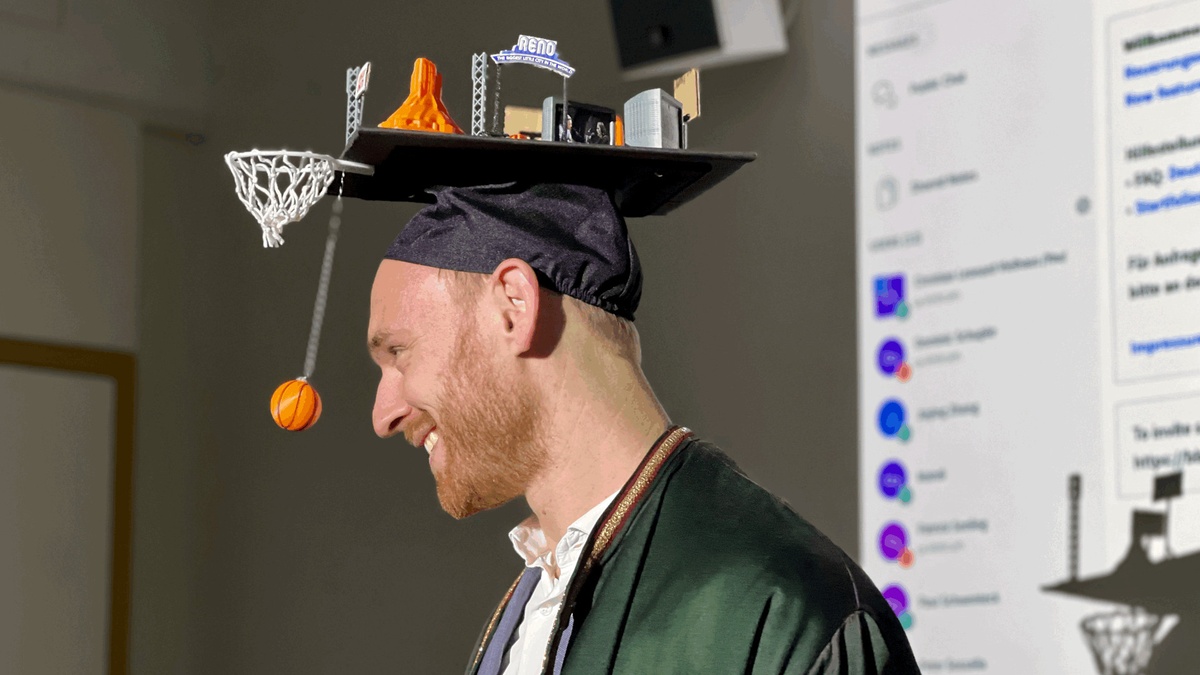
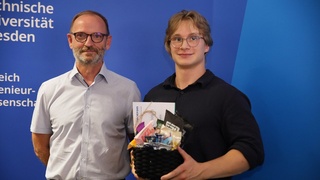
SECAI Congratulates Christian Vielhaus on His Doctorate
With Christian Vielhaus, another doctoral candidate has completed his dissertation at the SECAI Graduate School. Under the supervision of Fellow Frank H. P. Fitzek, he conducted research in the Novel Communication Technologies research group, focusing on the application of reinforcement learning algorithms in the field of congestion control.
The research group is conducting research in collaboration with the Technical University of Munich (TUM) on post-Shannon communication and related topics. Among other things, the aim is to enable applications in the field of the tactile internet that require high levels of latency and resilience. Christian Vielhaus worked there on the application of reinforcement learning algorithms in the field of congestion control and designed an algorithm that can compete with current state-of-the-art algorithms. The methodology for evaluating congestion control algorithms is a complex task for which there is very little research and software available. Consistent benchmarking is an essential aspect for making algorithms fairly comparable in the first place. He is now attempting to close this gap with a comprehensive evaluation methodology in the form of his software, ccperf.
In addition, his research focused on estimating key performance indicators (KPIs) in mobile networks, such as throughput or latency. It turned out that “simple” models like gradient boosting are sufficient for making accurate predictions. However, information from various locations within the network (the user’s device, base station, etc.) helps improve the accuracy of the estimation. It also proved advantageous to use many models for smaller areas (e.g., one model per base station) rather than a single larger model.
In addition to his research, Christian Vielhaus, as a founding member, has played a key role in establishing the SLAM (Simultaneous Localization and Mapping) startup Soron Systems. In collaboration with Dr. Justus Rischke, Johannes Hofer, and Fellow Frank H. P. Fitzek, the startup aims to enable autonomous navigation in previously unknown environments. Their research focuses on a method that allows mobile systems such as robots, drones, or vehicles to simultaneously create a map of their surroundings and determine their own position within it.
News All News
 © Ludwig Schmutzler