May 18, 2026
Law, Democracy, and AI: Charlotte Langer at the Hans Böckler Foundation’s Academic Conference
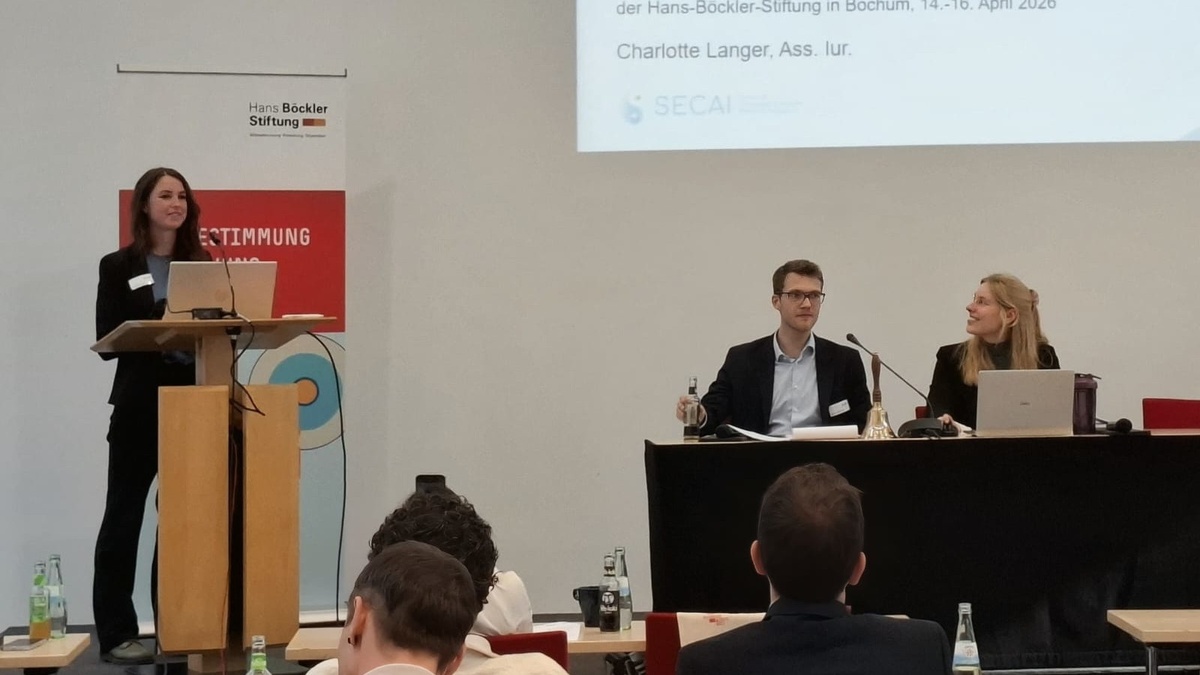
SECAI doctoral candidate Charlotte Langer attended this year’s Hans Böckler Foundation Doctoral Conference in Bochum. The conference was held under the theme “Law, State, and Democracy: Foundations of Freedom in 21st-Century Europe.” As part of an interdisciplinary panel on the topic of knowledge and uncertainty, she presented her work on the use of AI in public administration and the associated challenges and opportunities for democracy and the rule of law.
Interdisciplinarity is a core value of SECAI. This was also a key focus at this year’s Hans Böckler Foundation PhD Conference, held in Bochum from the 14th to the 16th of April. With a diverse audience representing a wide range of disciplines – including law, political science, and the social sciences, as well as theology, psychology, philosophy, and history – current and future challenges for democracy and the rule of law were discussed. The conference itself was designed to center on debate as the linchpin of democratic exchange – conducted fairly, constructively, and on equal footing. Consequently, the research findings and reflections presented in individual lectures were subsequently discussed vigorously with the audience. This gave rise to lively, productive debates on the fundamental principles of law and democracy from a variety of perspectives, which continued even beyond the lectures and inspired new approaches to solutions.
Artificial intelligence, in its many forms, was also discussed as a key challenge for the future facing the state and society. In her presentation, Charlotte Langer first outlined the technological foundations and the resulting challenges for the law and the democratic process of opinion-forming and discussion. She thus laid the groundwork for a subsequent assessment of the opportunities and risks of technological progress for liberal-democratic society in the 21st century.
About Charlotte Langer
Charlotte Langer studied law in Freiburg and Leipzig, specializing in international and European law as well as human rights. She is now a fully qualified lawyer and conducts research under the supervision of Prof. Stephanie Schiedermair at the intersection of constitutional law, administrative law, and digitalization. Her dissertation analyzes constitutional issues surrounding the use of AI in public administration. Other research projects have addressed legal issues surrounding AI-supported target selection in armed conflicts, the distribution of power and responsibility in the digitalized state, and the limits of administrative automation. In addition, she collaborated with Prof. Cristina Fraenkel-Haeberle of the Research Institute for Public Administration in Speyer on the creation of a comprehensive comparative law study on practical AI applications in the public sector.
News All News
 © Ludwig Schmutzler