October 7, 2026
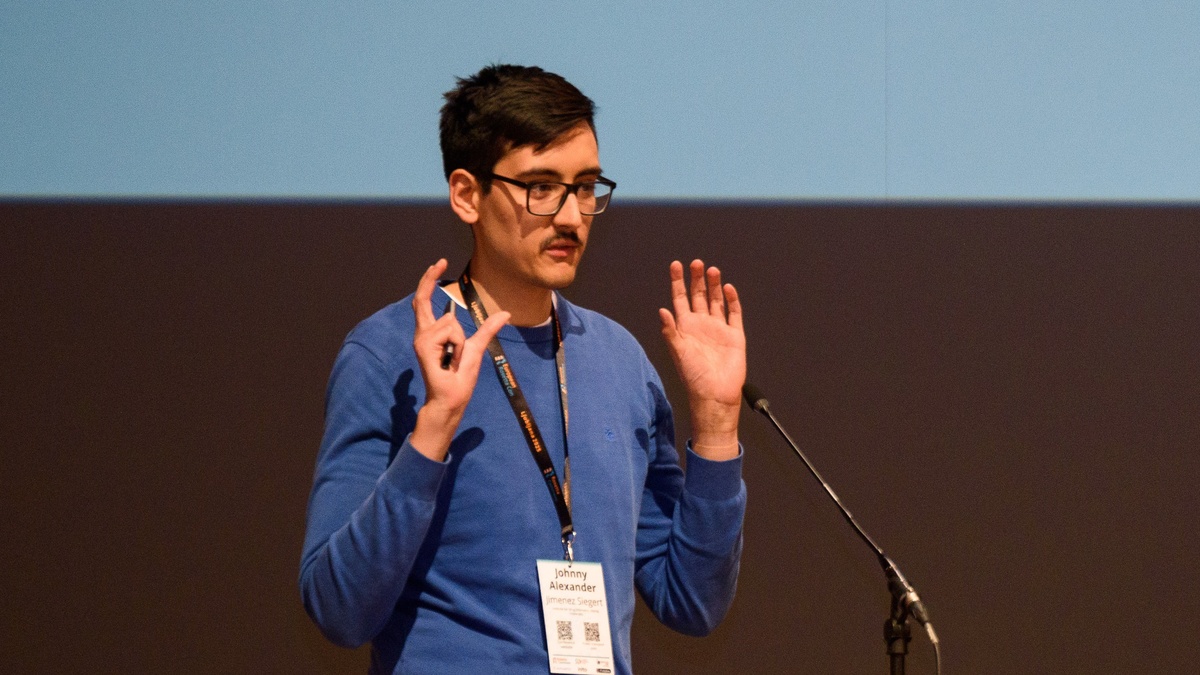
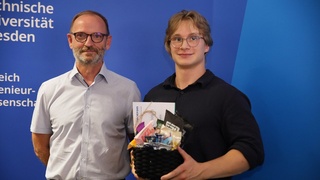
Johnny A. J. Siegert in the Meiler Lab Member Spotlight
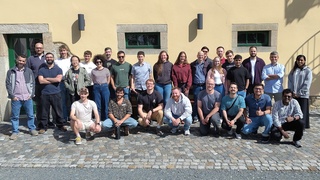
In this LabMemberSpotlight of the Meiler Lab, SECAI PhD student Johnny Alexander Jimenez Siegert introduces himself and his research. He is supervised by Fellow Jens Meiler and is part of his research group located at the Faculty of Medicine at Leipzig University. The group implements innovative computational approaches for drug discovery, investigates and models protein-protein interactions, and performs high-throughput ligand docking experiments, which enable the rapid prediction of possible binding between molecules and proteins.
„I trace my science career back to my participation as a high-schooler in the 2016 International Chemistry Olympiad. I went on to study chemistry at the Martin-Luther-Universität Halle-Wittenberg and wrote my Bachelor’s and Master’s theses in the lab of Prof. Daniel Sebastiani on ab initio molecular dynamics of solid-state proton conductors. Alongside my studies, I volunteered with the Friends of the Chemistry Olympiad (Förderverein Chemie-Olympiade e.V.) to support school students, especially in the competition Chemie - die stimmt!. There, I first met Prof. Jens Meiler when he gave a talk on computational drug discovery.”
“In 2023, I joined the MeilerLab as a member of the SECAI School of Embedded Composite AI and later the Center for Scalable Data Analytics and Artificial Intelligence (ScaDS.AI Dresden/Leipzig). My main project, in collaboration with Prof. Christian Georg Mayr’s group at Technische Universität Dresden, aims to accelerate ultra-large library screening with the neuromorphic SpiNNaker2 platform. As make-on-demand compound libraries grow to billions of compounds and beyond, we believe that hardware-software co-design will be crucial to keep virtual screening computationally feasible. SpiNNaker2, designed for massively parallel AI tasks, provides a promising platform to explore how specialized hardware can meet this challenge.”
“Recently, we published our results on ligand-based screening on SpiNNaker2 in Nature Portfolio Communications Chemistry. We found that compared to a system with a GPU, the SpiNNaker2 implementation was both faster and much more energy efficient. For our next steps, we have obtained a three-year grant in the Bundesministerium für Forschung, Technologie und Raumfahrt initiative “Anwendung von Künstlicher Intelligenz (KI) in der Wirkstoffforschung” to implement structure-based screening and quantum chemical methods on SpiNNaker2. By validating our approach against an established GPCR target, we will combine our institute’s computational and experimental capabilities to contribute to the next generation of hardware-accelerated virtual screening.”
News All News
 © Ludwig Schmutzler