July 15, 2026
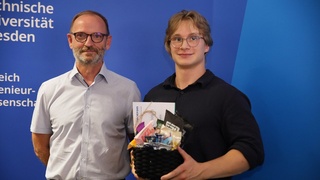
Jonas Karge Successfully Defends His Dissertation on Multi-Agent Belief Management
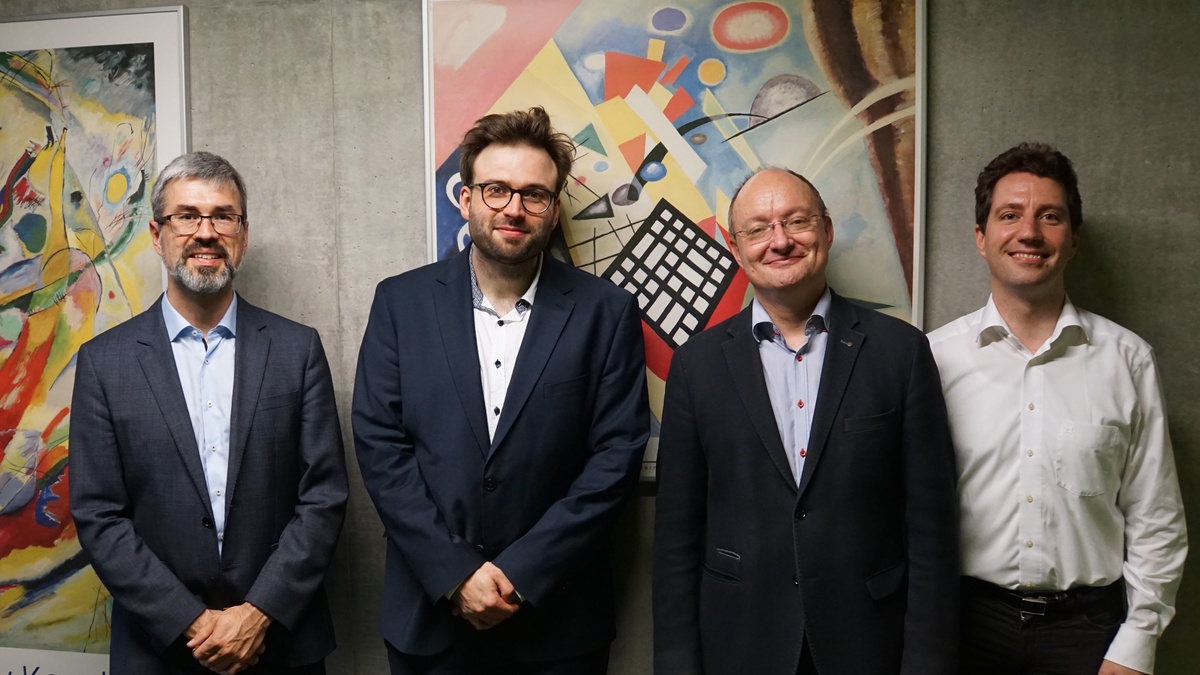
Jonas Karge successfully defended his dissertation on “Multi-Agent Belief Management” on July 2nd. In his research, he investigates the conditions under which groups can arrive at a correct assessment despite individual judgments that are uncertain, vary in reliability, or are interdependent. The dissertation was completed under the supervision of Fellow Sebastian Rudolph in the Computational Logic Group at the Institute for Artificial Intelligence at TU Dresden.
At the intersection of social choice theory, multi-agent systems, and formal epistemology, Jonas developed mathematical models that examine the conditions under which collective decisions can be made reliably, even in the presence of varying levels of expertise, shared influences, and incomplete information. His research also yielded new approaches to combining imprecise probability estimates and numerical estimates. His results demonstrate how, in particular, diversity, interdependencies among participants, and the choice of aggregation method affect the accuracy and robustness of collective decisions.
Since his research is strongly characterized by its interdisciplinary nature, Jonas benefited in particular from the ongoing academic exchange and the opportunity to develop ideas from various disciplines into shared formal research questions. One example of this was his research visit from March to May 2026 at the University of Cape Town. There, he worked with Associated Fellow Tommie Meyer and other researchers from the Artificial Intelligence Research Unit on the question of how AI systems can meaningfully combine human assessments and recommendations into a shared ranking, and under what conditions the influence of an AI system improves or worsens collective decisions. This collaboration resulted in an accepted workshop contribution and a follow-up conference contribution, which is currently under review.
During his doctoral studies, Jonas Karge established himself as a promising researcher in his field and presented his work at international conferences. For his paper “Taming Dilation in Imprecise Pooling,” he received the Martin Purvis Student Best Paper Award at PRIMA 2024 in Kyoto. In this paper, he investigated when combining imprecise probability estimates leads to an undesirable increase in uncertainty and under what conditions this effect can be mitigated. In addition, his dissertation was nominated by the School of Computer Science at TU Dresden for a school-wide award. In November 2024, he represented the three Konrad Zuse Schools of Excellence in Artificial Intelligence at a conference on generative AI, democracy, transparency, and sustainability in Tokyo.
News All News
 © Ludwig Schmutzler