July 9, 2026
Summa Cum Laude for Steffen Seitz's Doctoral Dissertation
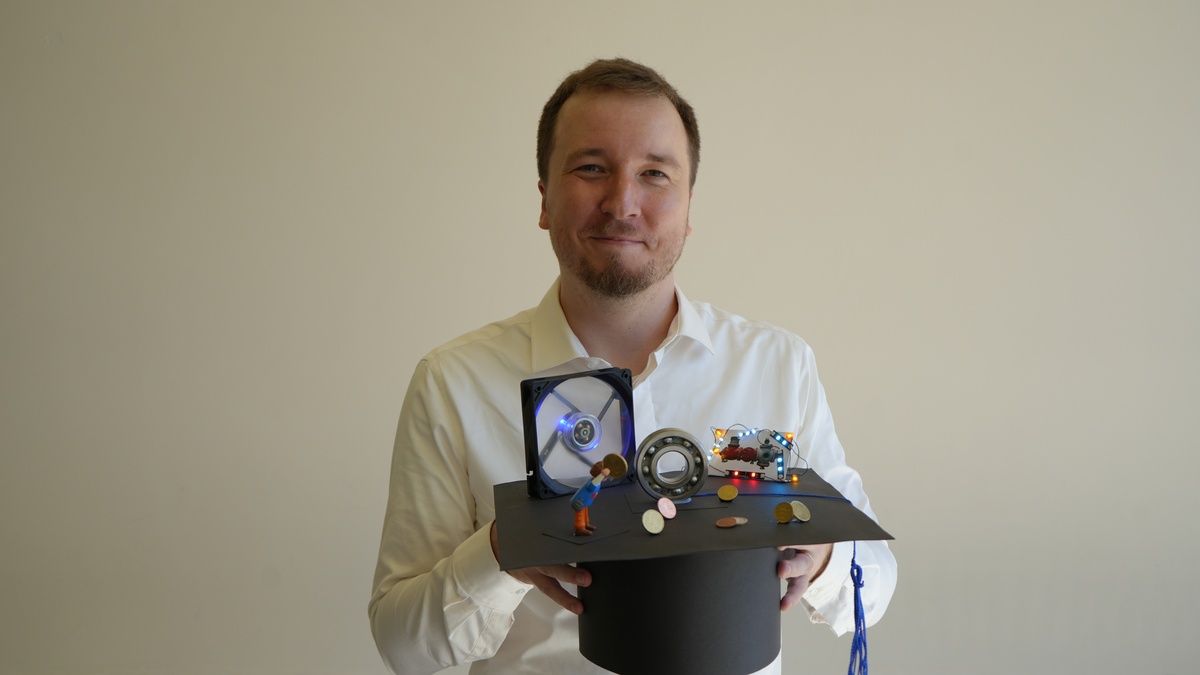
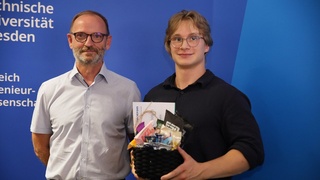
SECAI doctoral candidate Steffen Seitz successfully defended his dissertation on May 29, 2026, and received the highest grade, “summa cum laude.” Under the supervision of Fellow Prof. Dr. Ronald Tetzlaff, he developed an innovative method for the automated detection and visualization of machine wear in his research.
To determine the condition of machines and systems using artificial intelligence (AI) and visualize it over time, Steffen collaborated with Prof. Dr. Peter Holstein (TU Ilmenau/Sonotec) on a “weakly supervised learning” method specifically designed for this purpose. In this approach, an algorithm independently generates preliminary, so-called “weak” training labels, which are then used to train a second AI model. Using ball bearings as an example, the results showed that defects can be detected at a very early stage. The inevitable, minor inaccuracies in the automatically generated labels do not significantly impair the model’s performance. The system thus makes it possible to visualize and identify anomalies directly from the raw data – even before human experts can provide a reliable assessment based on the sensor data.
Another key result of his research was the development of a classification model for detecting partial discharges in gas-insulated high-voltage direct-current (HVDC) transmission systems. This task had previously been considered particularly challenging: Unlike conventional alternating-current (AC) systems, direct current lacks the phase information of the current that is typically used to identify such discharges. Nevertheless, the algorithm developed by Steffen in collaboration with Dr. Thomas Götz (Siemens Energy) was able to precisely classify the partial discharges in the HVDC system in terms of their polarity and discharge type.
Since such automation had previously been impossible, there was a growing need among experts to understand exactly how the AI model arrives at its decisions. As a result, Steffen’s research focus has increasingly shifted toward explainable AI (XAI) in recent years. With this in mind, he played a key role in establishing a dedicated subgroup for Explainable AI within the research group led by Fellow Prof. Ronald Tetzlaff, which he now heads.
News All News
 © Ludwig Schmutzler