 © DAAD/ Siegfried Michael Wagner
January 7, 2026
SECAI contributes to scientific exchange during the Zuse Schools Event
The annual Zuse Schools Event took place in Darmstadt from October 28 to 30. The three DAAD Zuse Schools – ELIZA, relAI, and SECAI – came together for networking and scientific exchange between the schools. On November 5 and 6, the SECAI On-Site Meeting took place. This is a project meeting for networking and for initiating and deepening research collaborations.
Zuse Schools Fall Event in Darmstadt
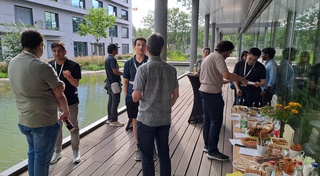
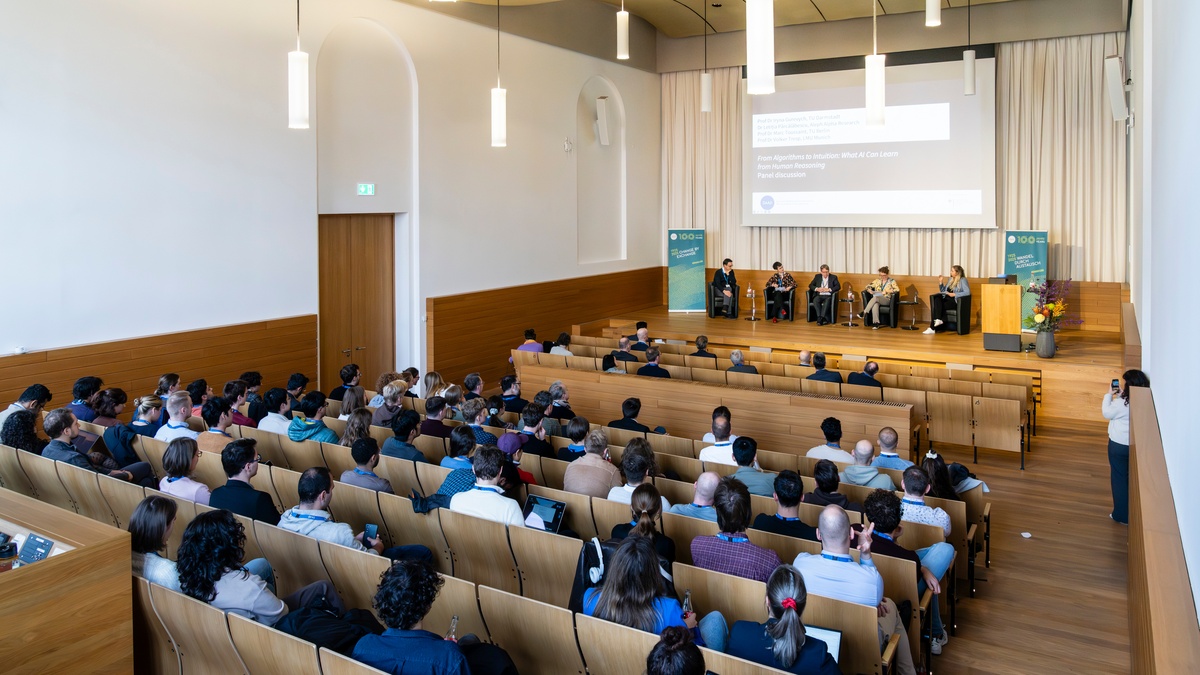
More than 100 PhD students, students, and fellows from the three Zuse Schools met in Darmstadt from October 28 to 30. This year's fall event was hosted by ELIZA, continuing the rotation of venues. The focus was on scientific exchange between the schools, supported by a diverse program of keynotes, lectures, and poster exhibitions. During the event, the PhD and MSc students presented their current projects via posters and lectures. The main day was rounded off with a robotics lab tour, which offered tangible insights into the current research of the Intelligent Autonomous Systems Group at TU Darmstadt.
Two keynotes received particular attention: Prof. Dr. Markus Reichstein highlighted the role of AI in modeling complex Earth systems and showed how data-driven methods are opening up new perspectives in climate research. Dr. Claudius Gläser spoke about current developments in the use of large language models and AI in the field of automated driving, an area of application that touches on key technological, regulatory, and ethical issues.
SECAI On-Site Meeting in Leipzig
 ©
©
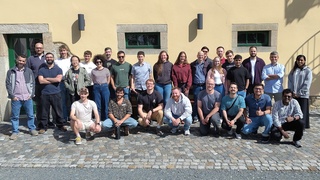
Group picture of the SECAI On-Site-Meeting 2025
A few days later, from November 5 to 6, around 40 participants gathered for the SECAI on-site meeting at the Max Planck Institute for Mathematics in the Sciences in Leipzig. In addition to doctoral students and fellows, several SECAI students took part to gain insights into current research work and establish initial contacts. The program was scientifically shaped by presentations from the new cohort, poster exhibitions, and in-depth lectures by advanced doctoral students.
Two keynote speeches set the thematic focus: Prof. Dr. Thomas Gärtner (TU Vienna) presented current work in the field of interactive machine learning for structured data, a research area that is particularly relevant for explainable and user-centered AI systems. Prof. Dr. Alexander Binder (Leipzig University) provided insights into new findings on stream value bounds and convergence properties of LRP attributions.
In addition, the start-up AI-Driven Therapeutics GmbH, which emerged from the research group of Fellow Jens Meiler, introduced itself. In a presentation and Q&A session, Ivan Ivanikov and Fabian Ließmann provided concrete insights into how a spin-off from university research can take place, based on their activities in the development of AI-supported therapeutic approaches.
News All News
 © Ludwig Schmutzler